Why Humidity Control Matters as Much as Temperature in a Wine Cellar
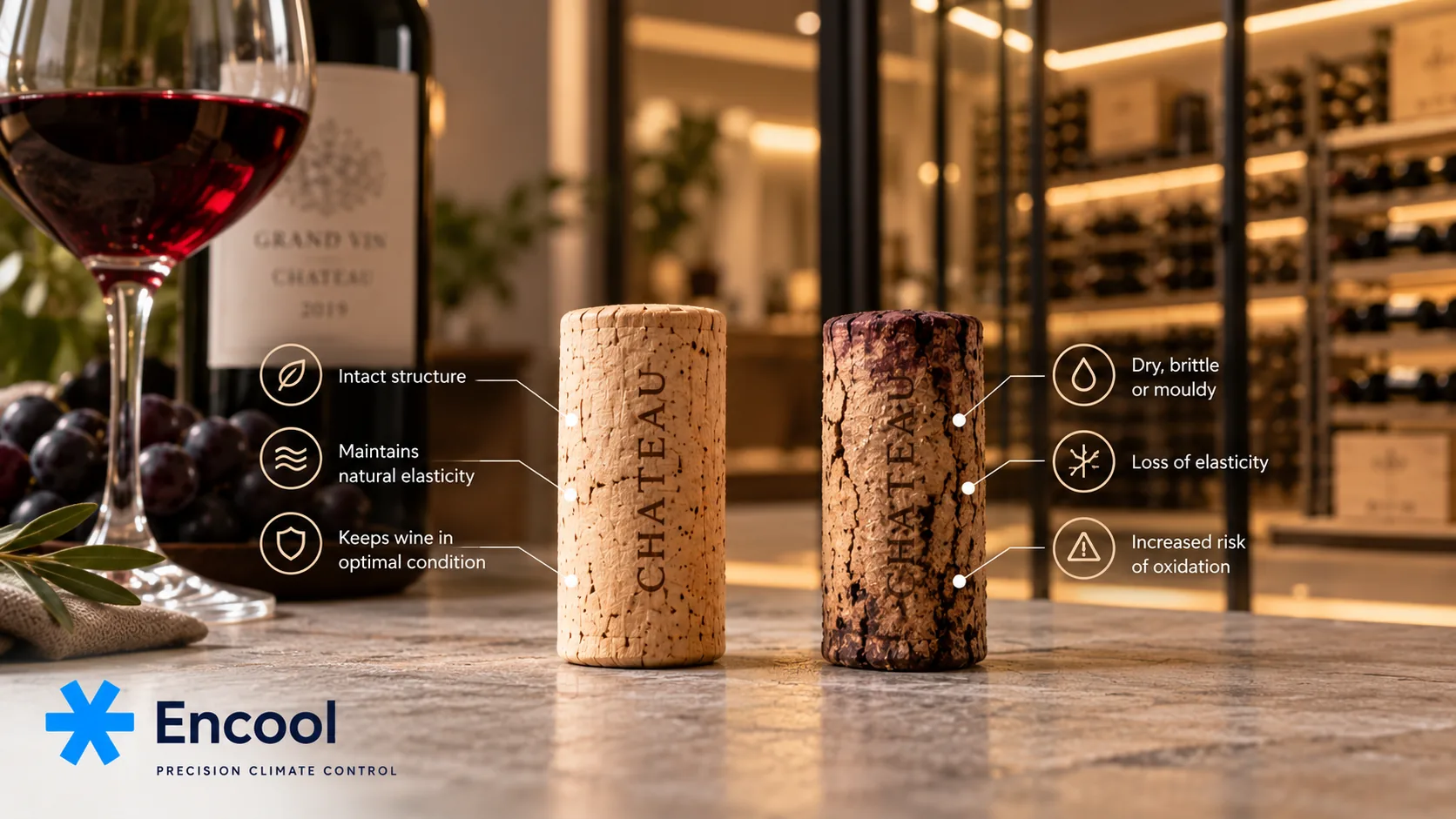
Quick answer: A wine cellar needs both a stable temperature (typically 12–14°C) and a stable relative humidity (typically 50–70% RH) to protect wine long-term. Temperature gets most of the attention when cellars are specified, but humidity is what protects the cork — too dry and corks shrink, letting in air and spoiling the wine; too damp and labels, capsules and cellar joinery suffer. Humidity control has to be engineered into the cooling system itself, not treated as an afterthought or a separate accessory.
What humidity actually protects
Cork is a natural material, and it relies on moisture to stay sealed against the bottle neck. In an environment that's too dry, cork dries out and contracts — even slightly — and once air can pass the seal, oxidation follows and the wine is compromised. This is a slower, quieter failure mode than temperature swings, which is exactly why it's easy to under-specify: a cellar can look fine and run at the right temperature for years while humidity silently does the damage.
At the other end, sustained humidity above roughly 70% RH creates its own problems — labels lift, capsules corrode, and mould risk increases, particularly on cellar joinery, racking and any porous surfaces in the room.
The commonly cited working range for long-term storage is 50–70% relative humidity, alongside the standard 12–14°C temperature band. Both numbers matter; neither compensates for the other.
Why humidity control is a cooling system problem, not a separate one
Refrigeration and humidity are physically linked: as a cooling coil removes heat from the air, it also condenses moisture out of it — the same process that produces condensation on a cold glass. Left unmanaged, a wine cellar cooling system tends to over-dry the air simply by doing its primary job of cooling.
That means humidity control has to be part of the cooling system's design, not bolted on afterwards. A system with integrated humidification — actively adding moisture back into the air to hold the target RH band — behaves very differently over a heating and cooling cycle than a system that only cools and dehumidifies by default, leaving humidity to whatever the room's air exchange happens to settle at.
What "integrated" should mean in practice
When integrated humidity control is specified correctly, it should mean active humidification, not just passive moisture retention — the system adds water vapour to the air when needed, rather than relying on the room being naturally humid enough; a controlled target band — typically 50–70% RH — maintained automatically alongside temperature, rather than requiring separate manual intervention; and no extra accessory purchase — humidity control built into the base specification of the cooling system, rather than an add-on module priced and fitted separately.
This is worth asking about directly when comparing cooling systems for a cellar project: is humidity control integrated into the unit as standard, or is it a passive side-effect of the cooling process that may or may not land in the right range?
Sizing still governs the outcome
As with temperature, humidity control only works if the underlying system is sized correctly for the room. An oversized unit short-cycles — it cools the air quickly, shuts off, and never runs long enough to condition humidity properly. An undersized unit runs constantly and can over-dry the space. The cooling load calculator is a starting point for getting this right; on cellars with unusual geometry, heavy glazing, or high door traffic, it's worth a proper specification conversation rather than working from the calculator figure alone.
FAQs
What's the ideal humidity level for a wine cellar?
Most guidance puts the target range at 50–70% relative humidity, alongside a stable temperature of 12–14°C. Both need to be held together — correct temperature with the wrong humidity still risks damaging the wine over time.
What happens if a wine cellar is too dry?
Low humidity dries out and shrinks natural cork, which can break the seal at the bottle neck and let air reach the wine, leading to oxidation. This tends to be a slow, easy-to-miss failure mode rather than an obvious one.
What happens if a wine cellar is too humid?
Sustained humidity above roughly 70% RH increases the risk of mould, and can damage labels, capsules and cellar joinery, even if the wine inside the bottle is unaffected.
Does a wine cellar cooling system automatically control humidity?
Not by default. Cooling removes moisture from the air as a side effect of the refrigeration process, which tends to over-dry a cellar unless the system includes active, integrated humidification designed to hold a target humidity band alongside temperature.