R32 Refrigerant and UK Wine Cellar Cooling: What Specifiers Need to Know in 2026
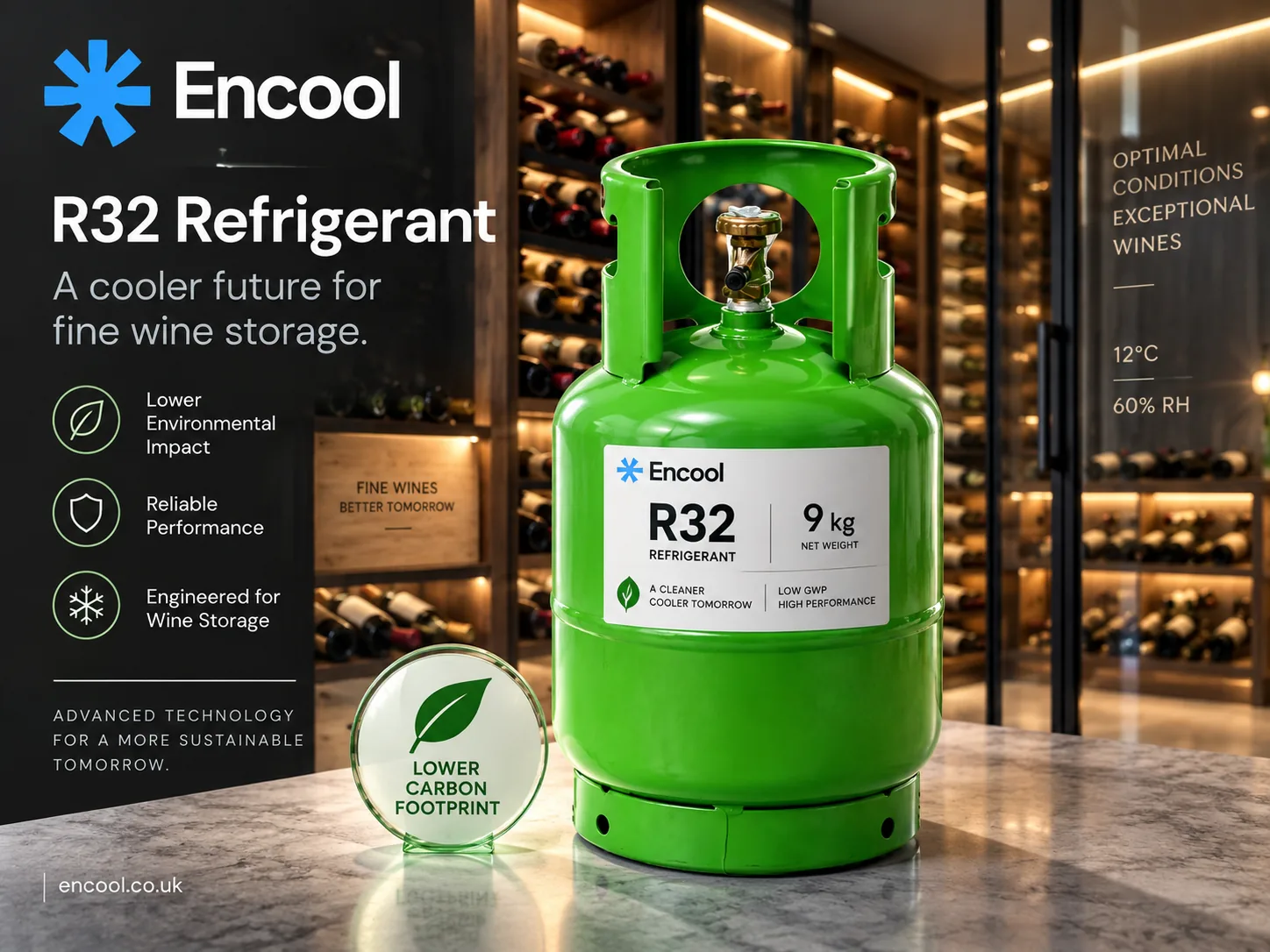
Quick answer: R32 refrigerant is legal to place on the market and use in Great Britain in 2026, in both commercial and residential settings, for room-cooling equipment such as ducted, ductless, through-the-wall and self-contained wine cellar cooling units. It sits well under the GWP thresholds that trigger a ban for this equipment category. Conditions apply around installer certification, leak checking and flammability handling — and Northern Ireland's position diverges from Great Britain's from 2027. This is a summary, not legal advice — check it against the specific product and, for anything contractual, get written confirmation from the manufacturer and a solicitor or F-gas consultant.
Refrigerant choice has become a live specification question in wine cellar cooling, as the trade moves away from R410A ahead of the 2025 ban on new equipment using high-GWP gases in small split systems. R32 is the refrigerant most of the market has moved to as a result — including THENOW Air's current UK range — so it's worth being precise about what is and isn't permitted.

Why R32 passes in Great Britain
Great Britain still runs the retained EU F-gas Regulation (517/2014). It bans specific equipment categories once their refrigerant's Global Warming Potential (GWP) crosses a threshold. R32 has a GWP of 675, which is comfortably under the limits that would exclude it from the equipment types used in wine cellar cooling: stationary refrigeration equipment is banned at GWP ≥ 2,500 (R32 passes), and single-split air conditioning under 3kg charge was banned from 1 Jan 2025 at GWP ≥ 750 (R32 passes — this ban is what moved the market off R410A).
Room-cooling units — ducted, ductless, through-the-wall and split systems — fall into these categories and are unaffected by the bans that do apply to R32 (which target hermetically sealed commercial refrigerators and freezers, movable air conditioning, and large centralised systems — none of which describe a wine cellar cooling split or self-contained unit).
There's no scheduled servicing or refill ban on R32 either — that restriction only bites gases with a GWP of 2,500 or above, such as the R404A it's often compared to.
One category to check carefully: sealed cabinets
The position above covers room-cooling equipment. It does not automatically extend to plug-and-play, hermetically sealed wine cabinets, which fall under a different equipment category — commercial refrigerators and freezers — where the GWP ban threshold is much lower (150) and has applied since 2022. R32 would not be a lawful refrigerant in that product category. This is why cabinet manufacturers across the market have moved to R290 for sealed units. If a specification includes both room-cooling systems and a sealed cabinet product, confirm the refrigerant for each separately — they are not interchangeable questions.
Conditions that come with legal use
R32 being permitted doesn't mean it's unconditional. Four things apply in practice: installer certification — any equipment needing field pipework or charging can only be sold to an end user with evidence that installation will be carried out by an F-gas certified installer, which should be a standard part of the order process, not an afterthought; leak checking — required above 5 tCO₂e, which for R32 equates to a 7.4kg charge, above most wine cellar cooling units, so routine leak checks and logbooks typically don't apply, though the specific unit's charge should be confirmed against this threshold rather than assumed; A2L flammability — R32 is classed as mildly flammable (A2L) under HSE DSEAR and ADR transport rules, meaning a room-volume-vs-charge calculation to the relevant British Standard is required for the specific installation (a wine cellar is often a small, sealed space, which is the binding constraint here, not the F-gas rules themselves), A2L-rated tools and detection equipment on site, and no retrofitting R32 into equipment designed for R410A; and labelling and quota-compliant supply of the refrigerant itself, as with any F-gas.
What changes, and when
The GB quota for HFCs (the gas family R32 belongs to) steps down from 2027, which is likely to put upward pressure on price and availability from that point, independent of legality. Worth watching if you're pricing multi-year framework agreements or long warranty terms.
Northern Ireland is a separate question. Under the Windsor Framework, Northern Ireland follows the newer EU F-gas Regulation rather than the GB rules — and the EU timetable is tighter. Self-contained air conditioning and heat pump equipment above the GWP 150 threshold is due to be banned in NI from 1 January 2027, with small split air-to-air systems following from 1 January 2029. In practice, an R32 system that's entirely compliant in Great Britain today may not remain sellable in Northern Ireland by the end of the decade — relevant to any specification described as "UK & Channel Islands" or "UK-wide," where NI needs calling out separately. The Channel Islands run their own refrigerant controls, outside both the GB and EU frameworks.
The specifier's takeaway
R32 is a compliant, current-generation refrigerant for wine cellar cooling equipment in Great Britain today, and the conditions around it — certified installation, an A2L-aware room calculation, correct labelling — are standard good practice on any F-gas installation, not a special burden created by this particular gas. The two things worth building into a specification process are: confirming which equipment category a given product actually falls into (room-cooling unit vs. sealed cabinet), and flagging Northern Ireland separately if the project could ever extend there.
This article summarises the general Great Britain F-gas position as understood in 2026. It is not legal advice. For a specific project, confirm the refrigerant, charge and equipment classification directly against the manufacturer's technical file, and take independent advice before relying on any of the above in a contract or specification document.
FAQs
Is R32 refrigerant banned in the UK?
No. R32 is legal to place on the market and use in Great Britain in 2026 for room-cooling equipment such as wine cellar cooling systems. It is not on any GB prohibition list for this equipment category and is not subject to a servicing or refill ban.
Why did the industry move from R410A to R32?
A GB F-gas Regulation ban on high-GWP refrigerants in small single-split air conditioning systems (charge under 3kg) took effect from 1 January 2025, effectively ending new R410A equipment in this category. R32, at a lower GWP, became the industry's standard replacement.
Is R32 the same for sealed wine cabinets as for split cooling systems?
No. Split, ducted, ductless and through-the-wall systems fall under stationary refrigeration/air conditioning rules, where R32 is compliant. Hermetically sealed commercial refrigerators and freezers — including plug-and-play wine cabinets — fall under a different, stricter GWP threshold that R32 does not meet, which is why sealed cabinet products have generally moved to R290 instead.
Does R32 require special installation?
Yes, in the same way any F-gas does, plus its A2L flammability classification: installation must be carried out and evidenced by an F-gas certified installer, and a room-volume-versus-refrigerant-charge check is required for the specific space under the relevant British Standard.