Large Wine Cellars
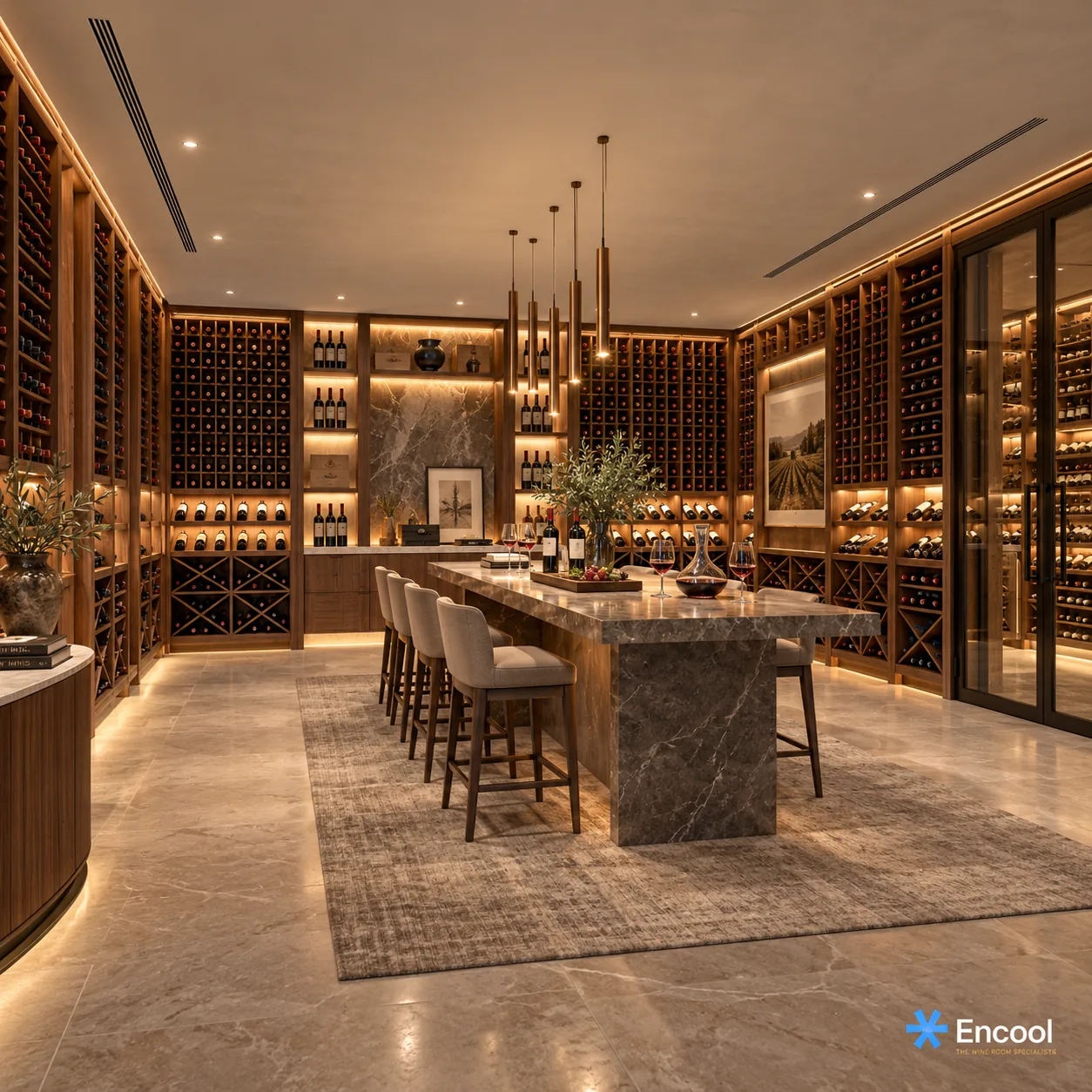
A large wine cellar is a different engineering problem to a small one.
Heat load, airflow, pipe runs, condenser siting and power supply all scale with room volume. What works for a 10m³ room does not simply scale up for a 60m³ or 150m³ cellar — the system, the services coordination and the planning all need to be addressed at the right scale from the start.
Encool supplies THENOW Air split cooling systems for large wine cellars from 15m³ up to 150m³, with the condensing unit sited away from the room itself.
For installers, M&E consultants and project teams, early planning is essential. The cooling system, electrical supply, pipe routing and condenser location should all be agreed before the room is built out.
.avif)
Why a large cellar changes the brief
A large wine cellar is rarely just a bigger version of a small one. It usually comes with:
Higher total heat load to reject
Longer refrigerant pipe runs between indoor and outdoor units
A condenser that needs a proper external or plant-room location
Greater electrical supply requirements
More racking, more bottles, more weight to plan for
Multiple room zones or an adjoining tasting/display area
Longer-term service access requirements
These are all planning questions, not just equipment questions — and they are far cheaper to resolve on a drawing than after the room is built.
Cooling systems for cellars from 15 to 150m³
Encool supplies four THENOW Air split systems that step up in capacity to cover large wine cellars.
The VHSN-J30 is an inverter split system designed for cellars of approximately 15 to 30m³. It offers cooling capacity from 1.6kW up to 2.5kW, heating output of 3kW, and quiet operation as low as 40dBA.
The HSN-J60 is designed for cellars up to 60m³, with cooling capacity of 3100W, heating output of 6000W, and a condenser that can be sited up to 18m from the indoor unit.
The HSN-J90 is designed for cellars up to 90m³, with cooling capacity of 5000W and heating output of 9000W.
The HSN-J150 is designed for the largest cellars, up to 150m³, with cooling capacity of 7600W, heating output of 12000W, and a condenser that can be sited up to 25m from the indoor unit. It is also the only system in this range that steps up to a 380V/50Hz power supply rather than 220V — a coordination point worth raising with the electrical contractor early.
THENOW Air split systems include built-in wet-film humidity control as standard, helping support the stable humidity band a large cellar needs alongside temperature.
Condenser siting and pipe runs
On a large cellar, the outdoor condensing unit is almost never in the room itself. Getting its location right affects noise, servicing access and system performance.
Points to agree early:
Where the condenser will sit — plant room, external wall, roof level or elsewhere
Maximum pipe run for the system selected (up to 18m on the HSN-J60, up to 25m on the HSN-J150)
Route for refrigerant pipework between indoor and outdoor units
Acoustic considerations if the condenser is near a neighbouring space
Access for future servicing and refrigerant work
Longer pipe runs and more complex routes are exactly where late-stage changes get expensive. Confirming the condenser location against the system's rated pipe run before first fix avoids abortive work later.
Electrical supply and drainage
Large cellar systems draw more power than small room units, and the HSN-J150 specifically requires a 380V/50Hz supply rather than the 220V used across the rest of the range. This needs to be flagged to the electrical contractor at first-fix stage, not assumed.
Condensate drainage and, where humidity control is specified, a water supply to the unit both need a planned route — the same as on smaller rooms, but with more volume to manage on the larger systems.
Multi-zone and adjoining spaces
Large cellars are sometimes one continuous volume, and sometimes several zones — a main storage area alongside a tasting room, display wall or entry vestibule. Where a project has more than one zone, each may need its own system sized to that zone's volume, rather than one oversized unit trying to condition the whole space evenly.
This is worth raising with Encool at the design stage, particularly on hospitality and high-end residential projects where a tasting or display zone sits alongside the main storage cellar.
Best suited to trade-led planning
Encool works with refrigeration engineers, HVAC contractors, M&E consultants, wine cellar specialists and verified trade buyers on large cellar projects.
Installation must be carried out by a suitably qualified F-gas engineer, and larger systems benefit from early coordination with the electrical and building services design.
Early support helps avoid the issues that show up most often on large cellar projects — condenser locations agreed too late, pipe runs that exceed the system's rated distance, or a power supply that was not sized for the unit selected.
Speak with Encool
If you are planning a large wine cellar, send us:
Room dimensions and total volume
Drawings or sketches, including any adjoining zones
Proposed condenser location
Pipe run distance from indoor to outdoor unit
Available electrical supply
Target temperature and humidity
Construction and insulation details
Service access constraints
We will help review the project and identify the right THENOW Air system, or combination of systems, for the space.
Speak to Encool about a large wine cellar cooling system