Ducted, Ductless or Through-the-Wall? Choosing the Right Wine Cellar Cooling System

Quick answer: Self-contained units suit small, accessible cellars where the unit can sit inside or adjacent to the room. Ducted split systems suit larger or architecturally sensitive cellars where the condensing unit needs to be sited remotely and ductwork can be concealed. Ductless (mini-split) systems suit mid-size cellars with a wall or ceiling position available for the indoor evaporator but no ducting route. Through-the-wall systems suit cellars with direct access to an adjoining garage, plant room or exterior wall. The right choice comes down to room volume, where heat can be rejected, and how much the installation needs to disappear.
Wine cellar cooling is a narrower, more demanding problem than domestic air conditioning: cellars typically need to hold 12–14°C and 50–70% relative humidity year-round, in a small, often sealed volume, regardless of the ambient conditions on the other side of the wall. That changes which system type actually works — and it's why the specification conversation should start with the system type, not the brand.
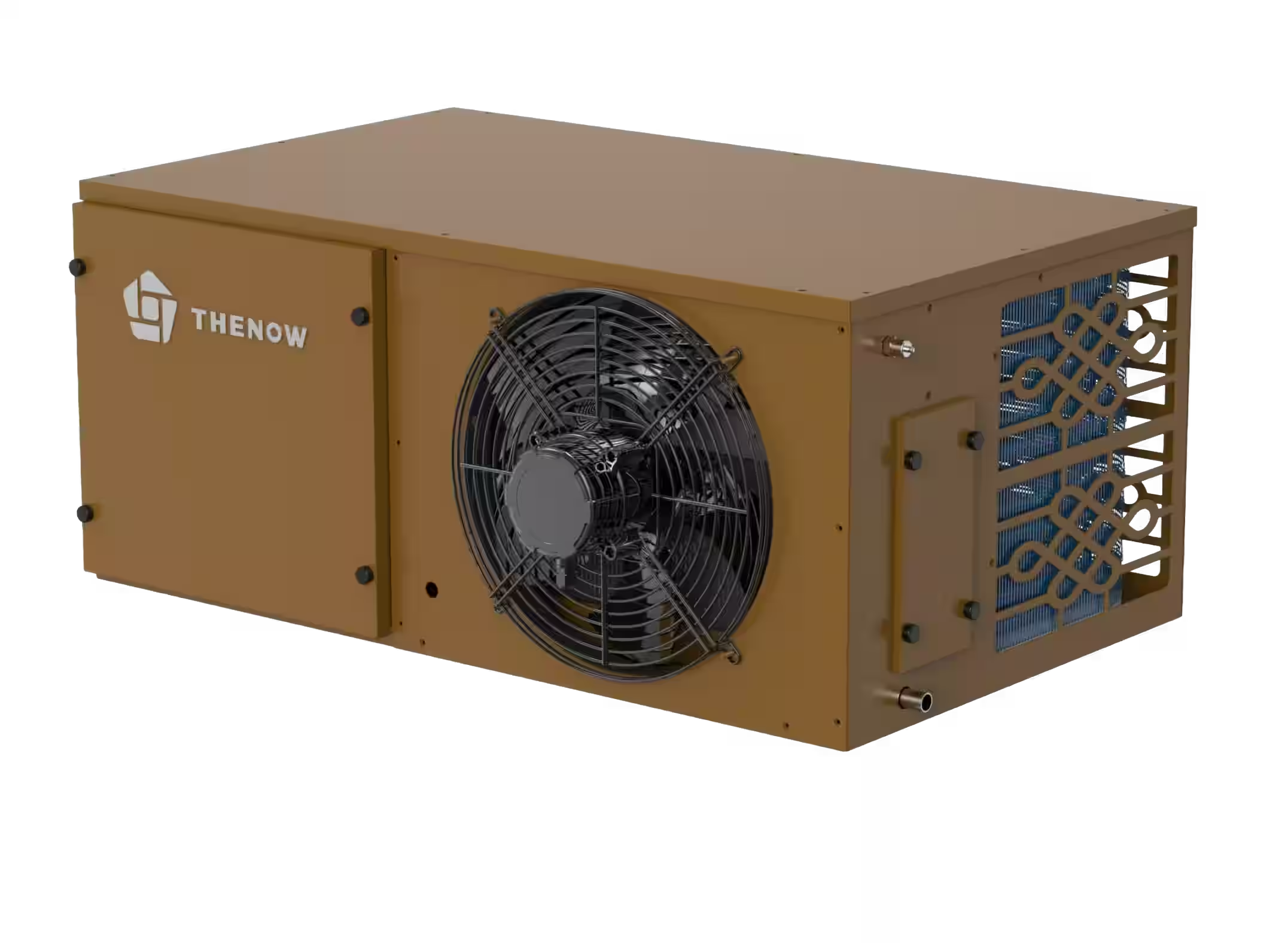
The four system types
Self-contained units
A self-contained (monobloc) unit houses the compressor, evaporator and condenser in a single enclosure, either inside the cellar or in an adjoining space with a duct run to the room. It's the simplest installation: one unit, minimal pipework, no separate outdoor condensing unit to site.
Best suited to: small to mid-size cellars where a compact unit can be positioned inside the room or immediately adjacent to it, and where a fully split system isn't justified by the room size or budget.
Watch for: heat rejection. A self-contained unit still has to put heat somewhere — either into an adjoining space with its own ventilation, or ducted out. If it's not accounted for at design stage, the unit works harder than it should and humidity control suffers.
Ducted split systems
A ducted split separates the condensing unit (compressor, outdoor coil) from the indoor evaporator, connected by refrigerant pipework, with the cooled air distributed to the cellar via ductwork. The condensing unit can be sited well away from the cellar — a plant room, garage, or outside — and the only thing visible in the cellar itself is a grille.
Best suited to: larger cellars, architecturally sensitive installations (heritage properties, high-spec joinery, glass-fronted cellars) where no visible equipment is acceptable, and projects where the condensing unit needs to sit some distance from the room.
Watch for: maximum pipe run and vertical lift. Every split system has a published limit on how far the refrigerant lines can run and how much vertical lift they can manage before performance drops — confirm this against the actual site layout before specifying, not after installation.
Ductless (mini-split) systems
Like a ducted split, a ductless system separates the condensing unit from the indoor unit — but the indoor evaporator is wall- or ceiling-mounted directly in the cellar, with no ductwork distributing the air further. It's a faster, simpler install than a full ducted run, while still allowing the compressor to sit outside the room.
Best suited to: cellars where a wall or ceiling position for the indoor unit is acceptable, ducting isn't practical or wanted, and the room is compact enough that a single point of air delivery is sufficient.
Watch for: placement. The indoor unit's position relative to racking, doorways and sightlines matters more in a ductless system than a ducted one, because it's visible in the finished room.
Through-the-wall systems
A through-the-wall unit sits within the thickness of a wall, rejecting heat directly into an adjoining space — typically a garage, plant room, or the outdoors — through a short duct rather than a full refrigerant pipe run. It avoids much of the pipework of a split system while still keeping the compressor out of the cellar itself.
Best suited to: cellars with a suitable adjoining space on the other side of an external or garage-facing wall, where a full split installation isn't needed or wanted.
Watch for: what's on the other side of the wall. This system type only works cleanly when the adjoining space can actually take the rejected heat and noise — a domestic garage is usually fine, a habitable room usually isn't.
Sizing comes before system type
Whichever system type suits the site, the unit still has to be sized to the room: volume, insulation standard, glazing, door frequency, and the target temperature and humidity band all feed into the calculation. Undersizing is the most common failure mode in wine cellar cooling — it shows up as a system that runs constantly, struggles to hold humidity, and shortens its own service life.
Use our cooling load calculator as a starting point, and treat any figure it returns as an input to a proper specification — not a substitute for one, particularly on cellars with unusual geometry, heavy glazing, or high door traffic.
A note on refrigerant
THENOW Air's current UK range runs on R32 — legal to place on the market and use in Great Britain today, across self-contained, ducted, ductless and through-the-wall system types, subject to standard F-gas conditions (installer certification, DSEAR/A2L handling, and a BS EN 378 charge-vs-room-volume check for the specific installation). Northern Ireland's position diverges from Great Britain's from 2027 onward under separate EU rules — worth flagging on any UK & Channel Islands vs Ireland-wide specification.
FAQs
What's the difference between a ducted and a ductless wine cellar cooling system?
A ducted system distributes cooled air through ductwork to one or more outlets, with the condensing unit sited remotely. A ductless (mini-split) system has a single wall- or ceiling-mounted indoor unit in the cellar itself, with no further ductwork — simpler to install, but the indoor unit is visible in the room.
Can a self-contained unit be used in a larger cellar?
It can, but heat rejection becomes the limiting factor — the unit needs somewhere to put the heat it removes from the cellar. Beyond a certain room size, a split system (ducted or ductless) with a remotely sited condensing unit is usually the more reliable specification.
Does system type affect humidity control?
Not directly — humidity control depends on the unit's design (THENOW's range includes integrated wet-film humidification as standard), not which of the four system types it's built into. What does matter is correct sizing: an oversized or undersized unit of any type struggles to hold a stable humidity band.
Is R32 refrigerant legal for wine cellar cooling in the UK?
Yes — R32 is legal to place on the market and use in Great Britain in 2026 for the room-cooling equipment types covered here, subject to standard F-gas conditions. See our detailed guide on R32 and UK compliance for the full position, including how Northern Ireland diverges.